THE COMPLETE SOLUTION / EDITORIAL REVIEW
COCOON
A distinctive spatial puzzle built from worlds that can be carried. Its carefully introduced containment rules create memorable deductions, with a guided structure that favours clarity over replay variety.

Game facts
- Developer
- Geometric Interactive
- Publisher
- Annapurna Interactive
- Released
- 29 September 2023
- Platforms
- Windows (Steam edition)
- Model
- Paid game
- PEGI
- 7 · Violence, Fear — Steam UK listing
- Players
- Single-player
- Length
- Short
- Difficulty
- 3 / 5 · Moderate
- Steam Deck
- Verified
PEGI source ↗ · Steam Deck status source ↗
Edition: Base game
The score, explained
The interest and responsiveness of the core decisions and actions.
How progression, exploration and goals fit together.
The coherence of the visual, musical and narrative presentation.
How clearly the game explains its rules and offers useful ways to engage.
The depth of optional goals, alternative approaches and reasons to return.
A world can also be a tool
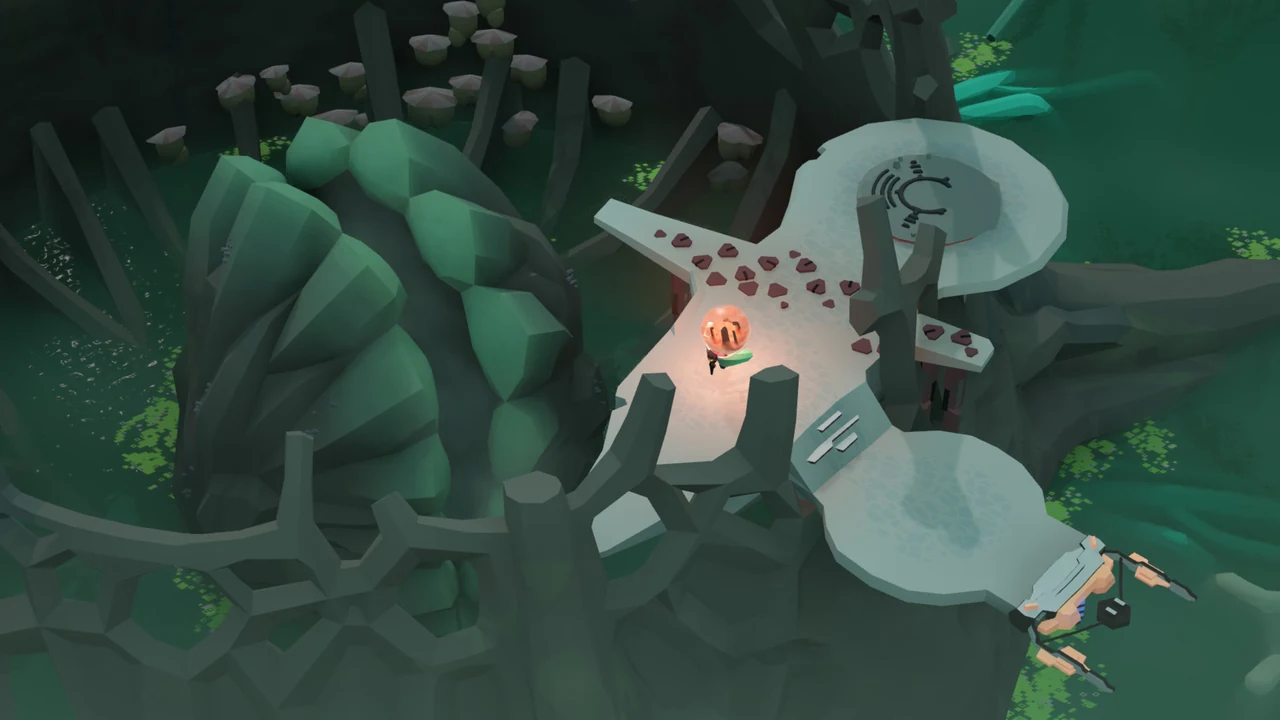
COCOON establishes an unusual spatial idea with remarkably little ceremony: an orb can be an object in one place and contain another world. Carrying, entering and placing these orbs forms the basic vocabulary of the opening puzzles. The player learns by observing the relationship between a platform, a socket and the world currently being held. What matters is not just where the character stands, but where a whole environment sits in relation to another. The early sequences introduce this hierarchy gradually enough to make the central idea approachable. There is little dialogue to interpret, so machinery, colour and environmental response provide the instructions. The puzzle reader's first task is to build an accurate mental model of containment. Once that model starts to work, an apparently simple relocation can have consequences across several connected spaces.
Rules that travel between environments
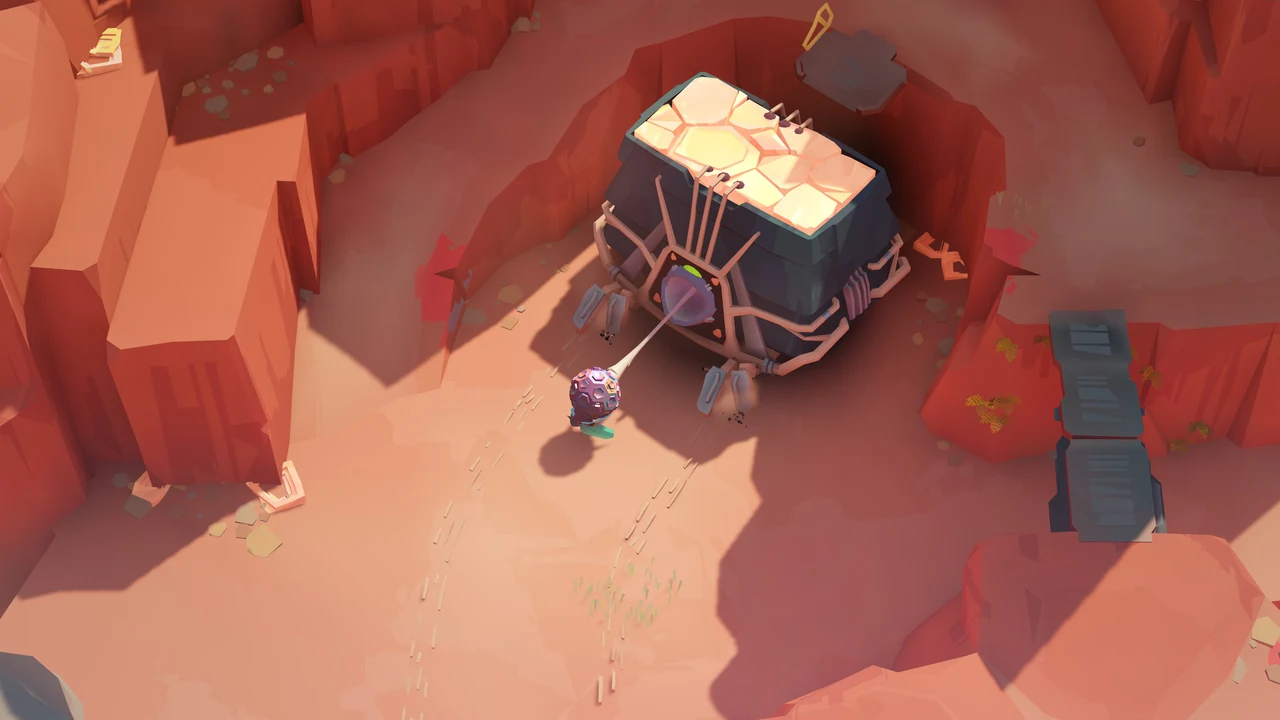
The elegance lies in how much the game derives from carrying one thing. Orb abilities and nested environments turn a familiar movement into a question about context: which world needs to be accessible, which object must remain outside, and what arrangement allows the next interaction? The design introduces these relationships through tangible spaces instead of a long written explanation. This makes an abstract problem feel physically understandable. Visual consistency also helps the player track which machinery and surfaces belong together. COCOON's strongest solutions often arrive when the arrangement is reconsidered as a whole, rather than when a hidden switch is finally found. That distinction gives the puzzles a satisfying conceptual centre. The player is learning to organise relationships among worlds, and each new complication asks for a more flexible use of the same underlying idea.
Alien spaces with a practical visual role
A clear central concept can still become mentally demanding when several relationships need to be held in mind. If the player loses track of which world contains which orb, retracing the arrangement may feel like administrative work before the actual deduction can resume. The adventure's tightly guided progression also leaves limited room for building a personal solution or approaching the main sequence in a different order. Encounters with guardians introduce more active demands, which may not appeal equally to every puzzle-focused reader. There is little dialogue or explicit explanation to offer reassurance when a spatial relationship has been misunderstood. The game generally communicates well through design, but it asks the player to trust that language. Its focused structure provides coherence at the expense of extensive replay variety once the important arrangements are understood.
Choose it for the connection between puzzles
Choose COCOON if you enjoy puzzles that change the way an object or space is conceptualised. It is particularly suited to players who like nested systems, spatial reasoning and a small interaction vocabulary used with increasing sophistication. The absence of heavy dialogue also makes it appealing when the aim is to think through a visual problem rather than read a large amount of text. Players who prefer open-ended construction or many interchangeable solutions should weigh its guided structure. The pleasure comes from discovering the intended relationship, not designing a completely different world. A patient approach to tracking containment will help more than searching every corner for an arbitrary clue. For readers attracted to that kind of reasoning, COCOON offers one of the catalogue's most coherent and memorable central puzzle ideas.
The verdict
A distinctive spatial puzzle built from worlds that can be carried. Its carefully introduced containment rules create memorable deductions, with a guided structure that favours clarity over replay variety.
Reasons to play
- A small set of actions supports substantial spatial reasoning
- Visual relationships teach the rules without lengthy explanations
- Solutions often require rethinking the whole arrangement
Reasons to think twice
- Tracking nested worlds can become mentally taxing
- The guided sequence offers limited alternative approaches after completion
See the game
Assist & accessibility
Explore the available settings and control options on the official game page before choosing your setup.
Parents’ guide
Players: Single-player. No in-game purchase marker in the checked Steam listing. Separate downloadable content may be sold.
Age classification: 7. Violence · Fear Steam UK listing
A useful starting tip
When an arrangement seems impossible, reconsider which world should contain which orb before searching for a new switch.
A different direction
Compare this with Chants of Sennaar: A thoughtful language deduction game in which understanding changes the world around you. The notebook supports careful inference, while mistaken assumptions and occasional stealth can interrupt the flow.
Official sources
Reviewed: November 2026
You might also like
 TUNICRead review →
 ANIMAL WELLRead review →
 DorfromantikRead review →