THE COMPLETE SOLUTION / EDITORIAL REVIEW
Chants of Sennaar
A thoughtful language deduction game in which understanding changes the world around you. The notebook supports careful inference, while mistaken assumptions and occasional stealth can interrupt the flow.

Game facts
- Developer
- Rundisc
- Publisher
- Focus Entertainment
- Released
- 5 September 2023
- Platforms
- Windows (Steam edition)
- Model
- Paid game
- PEGI
- 7 — Nintendo Switch download edition edition; not a separate PC classification
- Players
- Single-player
- Length
- Short
- Difficulty
- 3 / 5 · Moderate
- Steam Deck
- Verified
PEGI source ↗ · Steam Deck status source ↗
Edition: Base game
The score, explained
The interest and responsiveness of the core decisions and actions.
How progression, exploration and goals fit together.
The coherence of the visual, musical and narrative presentation.
How clearly the game explains its rules and offers useful ways to engage.
The depth of optional goals, alternative approaches and reasons to return.
Language is the obstacle and the tool
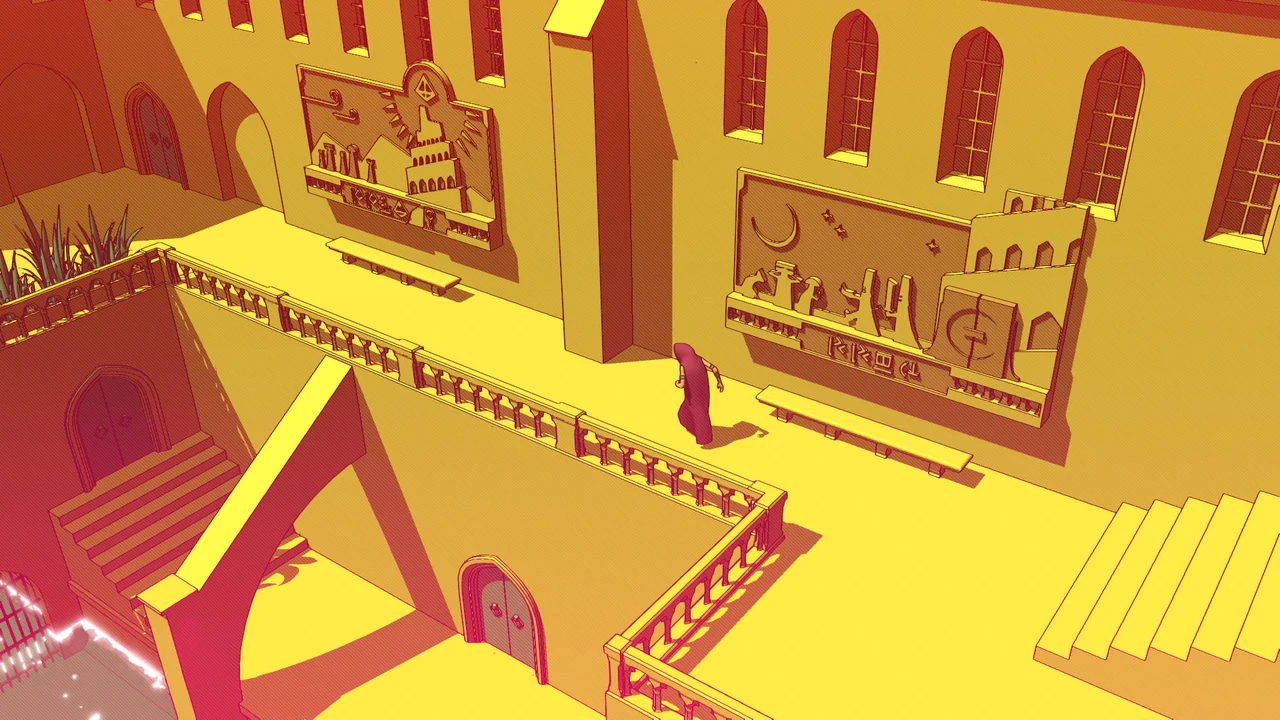
Chants of Sennaar makes uncertainty about language the starting point of its investigation. The tower's inhabitants speak in unfamiliar symbols, and the player has to infer meaning from gestures, repeated situations and the surrounding architecture. The notebook records working interpretations, giving guesses a practical place to develop. Early exchanges teach an important discipline: a meaning should explain several contexts, not merely fit the first scene in which a glyph appears. A sign beside a doorway and a similar mark in conversation may refine one another. Exploration therefore supplies evidence for the language, while the language makes more of the location understandable. The opening succeeds by making this loop tangible. You are not collecting vocabulary as trivia; each credible interpretation changes what can be understood, requested or attempted in the tower.
Separate communities become connected problems
The notebook turns a broad intellectual activity into a manageable game system. It encourages provisional thinking, then gives the player opportunities to connect symbols with clearer meanings. Different communities provide distinct visual and linguistic contexts, so moving upward asks for a fresh reading of both the people and their environment. This prevents the experience from becoming a single substitution cipher repeated indefinitely. The most rewarding deductions combine evidence from several sources: an action, a mural, a social role or a repeated phrase. Understanding then feeds back into navigation and the larger relationships among the tower's inhabitants. The design gives language a social purpose instead of treating words as isolated answers. For puzzle players, that makes each successful interpretation satisfying twice: a specific obstruction clears, and a once-incomprehensible place begins to make cultural sense.
The tower communicates before its words do
An incorrect assumption can spread further than expected. If a plausible early definition is accepted too readily, later scenes may be interpreted through that mistake, making the real clue harder to see. The notebook offers structure, but the game still requires a willingness to revise apparently settled ideas. Some progress also depends on exploring enough of an area to encounter the context that makes a word useful. Players who prefer every necessary clue gathered neatly into one room may find that wandering less efficient. Stealth sequences introduce a separate kind of attention and can interrupt the rhythm of deduction. Finally, much of the challenge depends on first discovering the languages, so replaying the same route naturally loses some of its intellectual surprise. The experience is strongest when uncertainty itself remains enjoyable.
Choose the pleasure of changing your mind
Chants of Sennaar is a particularly strong recommendation for readers who enjoy inference, language and the relationship between a community and the symbols it uses. It rewards patience with incomplete understanding, along with the ability to keep a theory provisional until several pieces of evidence agree. The game can be welcoming without being trivial because its notebook gives abstract reasoning a visible structure. Players who want constant objective certainty or primarily mechanical reflex challenges should consider whether its pace suits them. A willingness to revisit a conversation after learning something elsewhere is especially useful. The central pleasure is gradual comprehension: the same people and spaces become richer as the player understands them. If that sounds compelling, the tower offers a purposeful and unusually humane framework for a substantial deduction game.
The verdict
A thoughtful language deduction game in which understanding changes the world around you. The notebook supports careful inference, while mistaken assumptions and occasional stealth can interrupt the flow.
Reasons to play
- Multiple contexts give word meanings credible evidence
- The notebook supports provisional ideas and revision
- Language learning reveals the tower's social relationships
Reasons to think twice
- A wrong early assumption can distort later clues
- Stealth sections ask for a different kind of concentration
See the game

Assist & accessibility
Parents’ guide
Players: Single-player. No in-game purchase marker in the checked Steam listing. Separate downloadable content may be sold.
Age classification: 7. Nintendo Switch download edition edition; not a separate PC classification
A useful starting tip
Keep a word meaning provisional until it explains more than one context; a plausible first guess can make later scenes misleading.
A different direction
Compare this with COCOON: A distinctive spatial puzzle built from worlds that can be carried. Its carefully introduced containment rules create memorable deductions, with a guided structure that favours clarity over replay variety.
Official sources
Reviewed: November 2026
You might also like
 TUNICRead review →
 ANIMAL WELLRead review →
 DorfromantikRead review →