THE COMPLETE SOLUTION / EDITORIAL REVIEW
TUNIC
A remarkable investigation disguised as a fox's adventure. The changing meaning of its instruction manual makes discovery feel earned, provided you welcome substantial combat alongside the deductions.
Game facts
- Developer
- TUNIC Team
- Publisher
- Finji
- Released
- 16 March 2022
- Platforms
- Windows · macOS (Steam edition)
- Model
- Paid game
- PEGI
- 7 — Nintendo Switch download edition edition; not a separate PC classification
- Players
- Single-player
- Length
- Medium
- Difficulty
- 4 / 5 · Challenging
- Steam Deck
- Verified
PEGI source ↗ · Steam Deck status source ↗
Edition: Base game
The score, explained
The interest and responsiveness of the core decisions and actions.
How progression, exploration and goals fit together.
The coherence of the visual, musical and narrative presentation.
How clearly the game explains its rules and offers useful ways to engage.
The depth of optional goals, alternative approaches and reasons to return.
The manual is part of the adventure
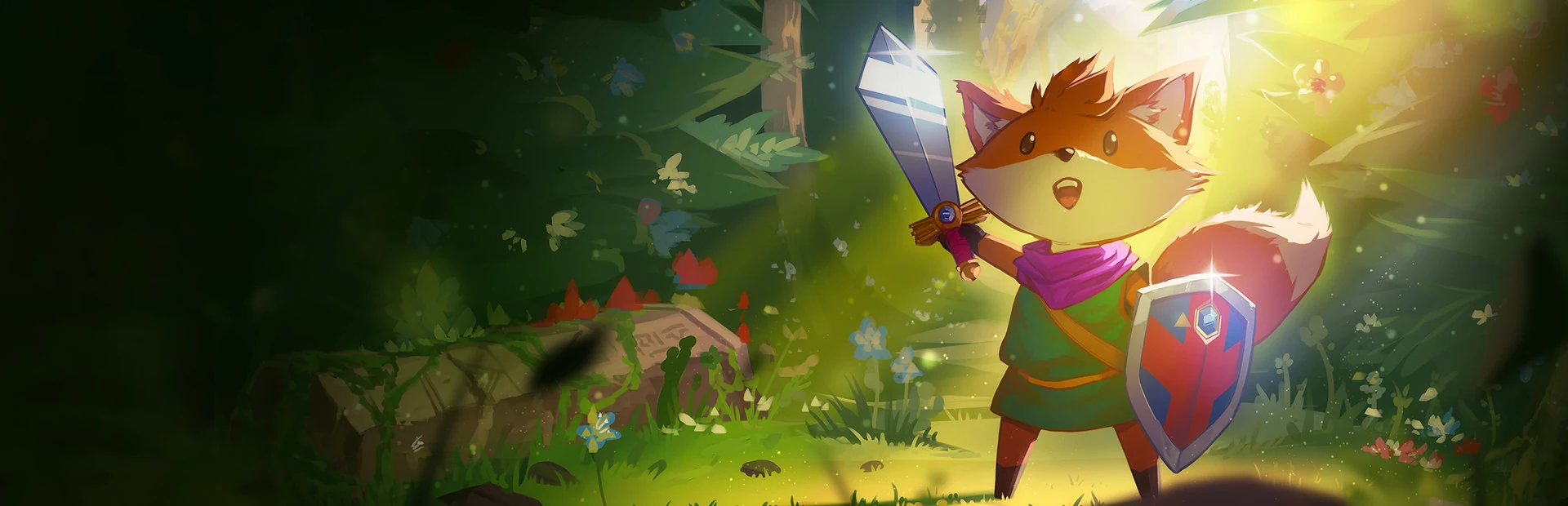
TUNIC makes the act of reading part of its adventure. A small fox reaches a landscape of locked routes, strange lettering and threatening creatures, while scattered instruction pages gradually supply a vocabulary for understanding it. The important early habit is to inspect a page as carefully as a room. Diagrams, marginal marks and familiar shapes can carry information that the surrounding script conceals. Meanwhile, finding a sword and learning the rhythm of movement give the investigation a physical cost: knowledge still has to be carried through dangerous places. For a puzzle reader, this creates an unusually productive uncertainty. A blocked passage may require an object, a different approach or an instruction that has been sitting in the manual all along. Progress begins with learning to distinguish those possibilities.
Knowledge changes familiar places
The manual is a powerful puzzle device because it changes the status of evidence. What first resembles decorative world-building can become an actionable instruction after another discovery. Revisiting an illustration therefore feels like revisiting a location with a new tool. TUNIC also connects its spaces tightly enough for this change in understanding to matter: a shortcut or overlooked opening revises the mental map instead of merely adding another destination. Its deeper mysteries extend that approach across multiple pages and landmarks. The resulting satisfaction comes from assembling a rule that explains several observations at once. This is strong puzzle design, particularly for players who enjoy keeping notes, comparing symbols and testing a theory against the environment. The fox's journey supplies a coherent setting for those deductions rather than presenting them as a separate collection of riddles.
A small hero in a carefully framed world
TUNIC's two demands can pull in different directions. A player may understand a spatial problem perfectly and still struggle with the fight guarding its solution. Equally, competence with a sword offers little help when the next obstacle is an uncertain interpretation of a diagram. The game deliberately leaves room for mistaken assumptions, which can turn a productive mystery into an extended search through places already visited. Its late puzzles also ask for sustained attention to details that initially appear incidental. That escalation is exciting when a theory begins to connect, but less welcoming if progress needs to remain obvious. Assistance options can ease the physical challenge; they do not replace the patience needed to examine the manual. Expect stretches of contemplation between the more immediately readable exploration and combat rewards.
For curiosity that survives confusion
Choose TUNIC for the pleasure of discovering how a game communicates its own rules. It particularly suits puzzle players who like drawing connections across an entire adventure, rather than solving a sequence of self-contained rooms. A willingness to return to old evidence is more valuable than rushing towards every visible objective. The manual also makes it a good game to discuss with a friend who enjoys comparing interpretations, even though the adventure itself is single-player. Players primarily looking for a straightforward action progression should weigh the concealed information carefully. The strongest recommendation is for curious explorers comfortable with both uncertainty and combat, or with adjusting combat assistance to preserve the investigation. Approach each new page as a working document, and the world becomes considerably more interesting than its inviting first appearance suggests.
The verdict
A remarkable investigation disguised as a fox's adventure. The changing meaning of its instruction manual makes discovery feel earned, provided you welcome substantial combat alongside the deductions.
Reasons to play
- Manual pages turn observation into practical knowledge
- Connected routes reward revisiting a theory
- Late mysteries build on ideas encountered earlier
Reasons to think twice
- Combat can interrupt an otherwise understood solution
- Progress sometimes depends on reinterpreting a very small clue
See the game
Assist & accessibility
Explore the available settings and control options on the official game page before choosing your setup.
Parents’ guide
Players: Single-player. No in-game purchase marker in the checked Steam listing. Separate downloadable content may be sold.
Age classification: 7. Nintendo Switch download edition edition; not a separate PC classification
A useful starting tip
Revisit a collected manual page after making a discovery; an illustration that looked decorative may now contain a useful instruction.
A different direction
Compare this with ANIMAL WELL: An inventive habitat of interlocking mysteries. Its small inventory supports unusually rich experimentation, while the sparse guidance makes patience an essential part of the experience.
Official sources
Reviewed: November 2026
You might also like
 ANIMAL WELLRead review →
 DorfromantikRead review →
 Into the BreachRead review →