THE COMPLETE SOLUTION / EDITORIAL REVIEW
Strange Horticulture
A shop-counter mystery whose strongest decisions start with a leaf, a description and careful doubt. Plant descriptions and map clues make careful reference work the centre of a coherent detective loop.

Game facts
- Developer
- Bad Viking
- Publisher
- Iceberg Interactive
- Released
- 21 January 2022
- Platforms
- Windows · macOS (Steam edition)
- Model
- Paid game
- PEGI
- 7 — Nintendo Switch edition; not a separate PC classification
- Players
- Single-player
- Length
- Short
- Difficulty
- 2 / 5 · Approachable
- Steam Deck
- Verified
PEGI source ↗ · Steam Deck status source ↗
Edition: Base game
The score, explained
The interest and responsiveness of the core decisions and actions.
How progression, exploration and goals fit together.
The coherence of the visual, musical and narrative presentation.
How clearly the game explains its rules and offers useful ways to engage.
The depth of optional goals, alternative approaches and reasons to return.
The shop counter is your investigation desk
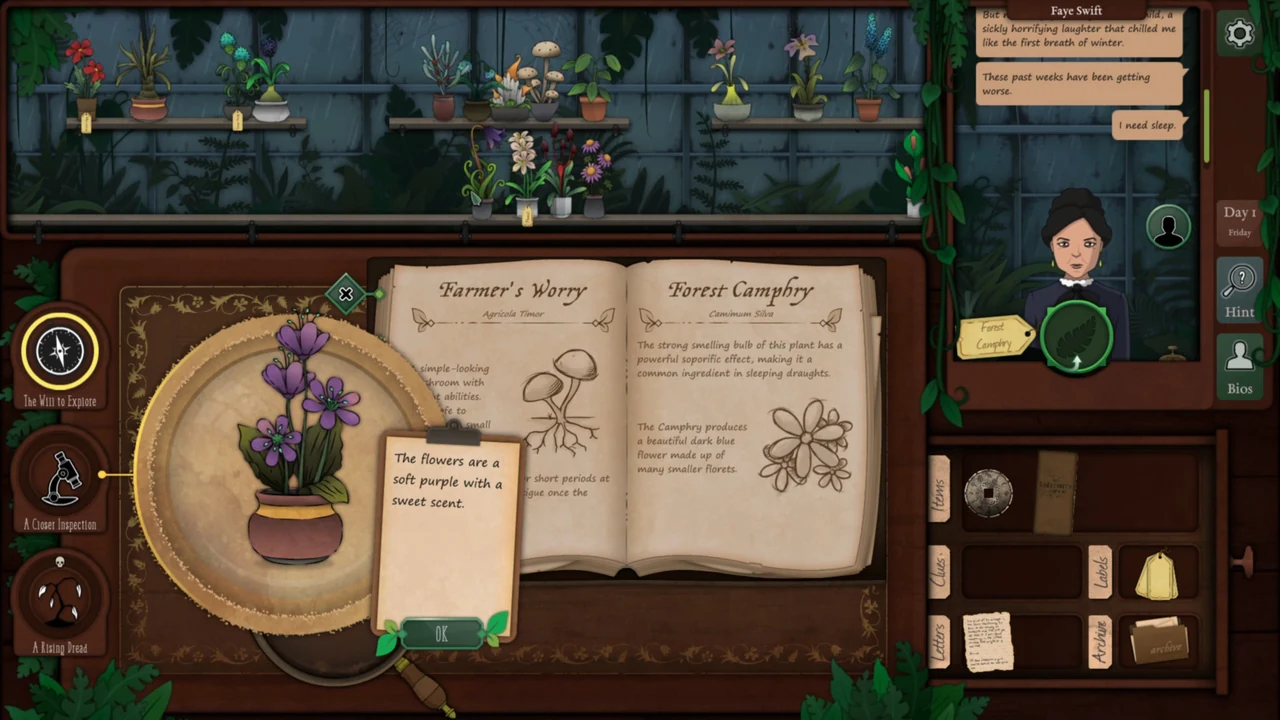
Strange Horticulture casts you as the owner of a plant shop drawn into the mysteries around Undermere. Identifying a specimen means using a reference book and clues rather than simply recognising a familiar garden flower. The activity makes deduction tangible: compare what you can observe with what you have learned, then decide whether the evidence is sufficient. We rate this core idea highly because the plant is both a puzzle object and something that can affect the wider story. It is not a gardening simulator built around watering schedules or a production economy. Readers who enjoy patient comparison and close reading have a clear reason to look further; anyone wanting rapid action should expect a deliberately different pace.
Clues connect the shelves to the map
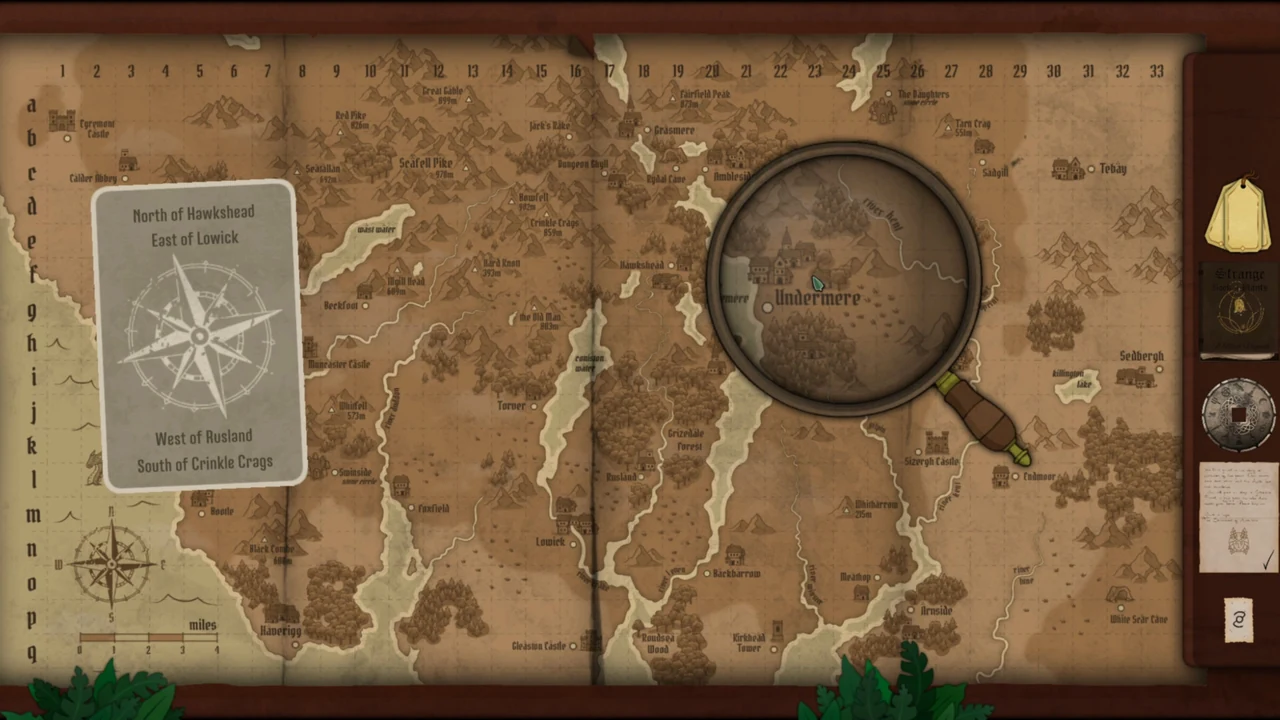
Customers and discoveries pull the shop into an occult story, while exploring the surrounding area provides new plants and information. The game makes the map more than a destination list: contextual clues help determine where to investigate and which places may be dangerous. That relationship between desk work and the wider landscape gives the structure a useful rhythm. A new specimen can change what a passage in the book means, and a clue can turn a previously unremarkable location into a target. Our assessment values the way information stays relevant across these activities. The possible friction is straightforward: progress depends on noticing and interpreting details, so a player who skims text may find the mystery less welcoming than its compact shop setting initially suggests.
Comfort with an unsettling edge
A cat, a plant shop and a reference book might suggest a purely cosy game, but Strange Horticulture explicitly includes cults, poisons and other occult dangers. That mixture is central to its identity. The familiar counter gives the player a place to organise information while the surrounding story makes each request less straightforward than an ordinary sale. We rate the atmosphere highly because it supports the act of questioning what a plant or customer really means. The darker themes also deserve consideration independently of the game's relatively quiet interaction style. A lack of fast combat does not make a story emotionally neutral. This is a recommendation for readers who enjoy unease and mystery alongside the practical satisfaction of identifying something correctly.
For people who like evidence before answers
Strange Horticulture fits a reader who wants to move carefully from observation to conclusion. The available ability to use plants to influence the story gives decisions weight beyond adding another name to a collection. Returning may reveal other possibilities, but knowing the identification puzzles inevitably changes their character, so our return score is more restrained than the core-play score. If close reading is not appealing, A Little to the Left offers a better match for visual pattern finding in shorter, more isolated puzzles. Choose Strange Horticulture when you want the reference material, the physical objects and the surrounding mystery to feel like parts of one investigation. Its strongest promise is a useful reason to be attentive, not a rush of constant surprises. Plant descriptions and map clues make careful reference work the centre of a coherent detective loop.
The verdict
A shop-counter mystery whose strongest decisions start with a leaf, a description and careful doubt. Plant descriptions and map clues make careful reference work the centre of a coherent detective loop.
Reasons to play
- Plant identification gives investigation a tangible process
- The map and reference book make clues useful
- Decisions connect the shop's work to the wider mystery
Reasons to think twice
- Careful reading is central to progress
- The occult subject matter is darker than a conventional gardening game
See the game
Assist & accessibility
Explore the available settings and control options on the official game page before choosing your setup.
Parents’ guide
Players: Single-player. No in-game purchase marker in the checked Steam listing. Separate downloadable content may be sold.
Age classification: 7. Nintendo Switch edition; not a separate PC classification
A useful starting tip
Compare several identifying details before naming a plant; one matching feature is not the same as a complete identification.
A different direction
Compare this with A Little to the Left: A tidy collection of small visual puzzles with useful hints and room for alternative solutions. Its household arrangements offer smaller, self-contained problems and a gentler entry point than the mystery-heavy adventures.
Official sources
Reviewed: November 2026
You might also like
 TUNICRead review →
 ANIMAL WELLRead review →
 DorfromantikRead review →