THE COMPLETE SOLUTION / EDITORIAL REVIEW
Chicory: A Colorful Tale
A warm, inventive adventure whose brush connects expression with exploration. Its puzzles work best for players who welcome the character story and the freedom to leave their own marks.

Game facts
- Developer
- Wishes Ultd., Greg Lobanov, Alexis Dean-Jones, Lena Raine, Madeline Berger, A Shell in the Pit
- Publisher
- Finji
- Released
- 10 June 2021
- Platforms
- Windows · macOS (Steam edition)
- Model
- Paid game
- PEGI
- 7 — Nintendo Switch edition; not a separate PC classification
- Players
- Single-player · Multi-player · Co-op · Shared/Split Screen Co-op
- Length
- Short
- Difficulty
- 2 / 5 · Approachable
- Steam Deck
- Verified
PEGI source ↗ · Steam Deck status source ↗
Edition: Base game
The score, explained
The interest and responsiveness of the core decisions and actions.
How progression, exploration and goals fit together.
The coherence of the visual, musical and narrative presentation.
How clearly the game explains its rules and offers useful ways to engage.
The depth of optional goals, alternative approaches and reasons to return.
The brush is the main tool
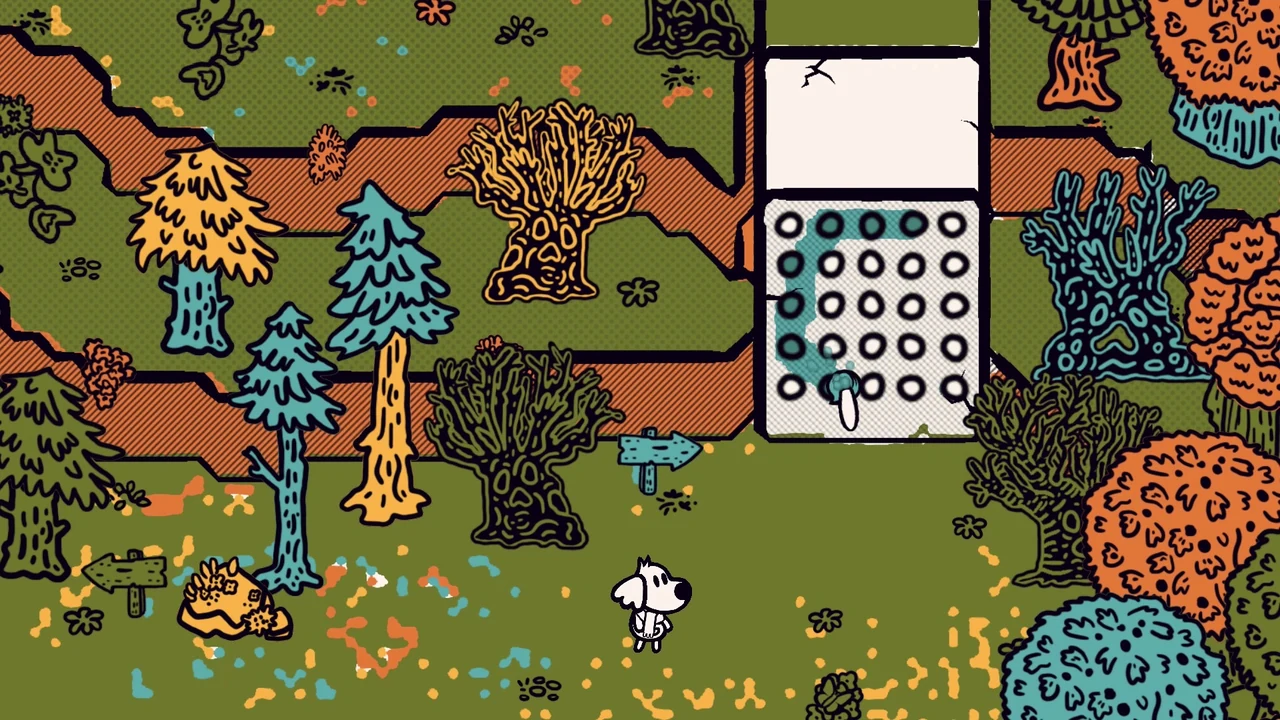
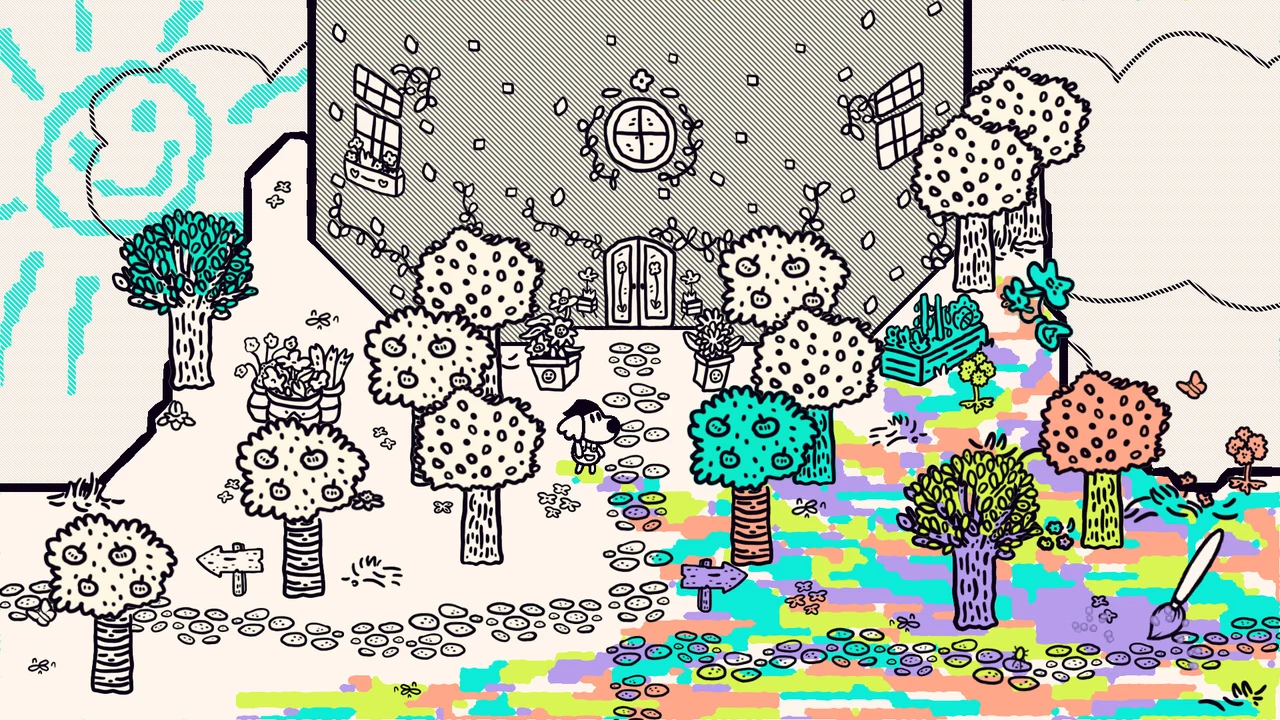
Chicory gives the player a brush before asking them to think of it as a conventional adventure tool. Its monochrome world invites colouring, but the early tasks also establish that painted surfaces and environmental response can carry practical meaning. Following requests and exploring the connected locations gradually turns free expression into a way of investigating the world. The useful habit is to test a suspicious surface rather than assume every obstacle needs a key. New brush abilities expand that relationship over the course of the adventure. For puzzle readers, the opening feels unusually forgiving: observation and experimentation happen within a world that visibly accepts personal marks. The drawing does not need to be polished to matter. What counts is noticing where colour changes the situation and where a character's request suggests another application.
Abilities that expand a familiar idea
The brush works because it unifies decoration, interaction and the story's interest in creativity. Painting is not merely a reward layered over progress; it is the action through which the player learns what a place allows. As abilities expand, familiar surfaces can take on new uses, encouraging a fresh look at areas that already feel personally coloured. The adventure also avoids demanding artistic skill as the price of participation. A rough experiment can be mechanically useful and emotionally appropriate to its themes. That gives puzzle-solving a welcoming texture without making every interaction identical. The player moves between interpreting requests, finding routes and testing new capabilities. Local cooperative colouring adds another way to engage with the same spaces, though the central adventure still has a clear protagonist and direction to follow.
A world that leaves room for you
Chicory's freedom creates a mild conflict of attention. A player can spend considerable effort making a location look pleasing while the adventure's actual next step lies elsewhere. Someone focused on solving the main route may instead find optional colouring too loosely defined to feel like a substantial puzzle. Its challenge also changes form during the journey, mixing environmental work with more active confrontations. Those sequences do not offer the same leisurely pace as examining a surface or considering a request. The story's discussion of creative pressure gives the activity weight, but readers who only want an intricate mechanical puzzle system may find the emotional material more prominent than expected. The game is most coherent when its expressive and practical sides are both welcome. Treating either side as an interruption weakens the experience.
For curiosity rather than competition
Choose Chicory when you want puzzles embedded in an expressive, character-led adventure. It suits players who enjoy trying a tool on the environment and seeing a visible response, especially if the freedom to personalise that environment is part of the appeal. Artistic confidence is unnecessary; curiosity and a willingness to make untidy experiments are more useful. The game can also be inviting for people who find an austere puzzle interface unwelcoming, because the world constantly offers something tangible to do. Players seeking relentless difficulty or a highly competitive test should set different expectations. This is a thoughtful blend of exploration, drawing and progression. Its best audience is interested in how a practical ability can become a form of expression, and how that expression can lead back into solving the adventure's next problem.
The verdict
A warm, inventive adventure whose brush connects expression with exploration. Its puzzles work best for players who welcome the character story and the freedom to leave their own marks.
Reasons to play
- Painting gives environmental investigation an expressive form
- New brush abilities make familiar places worth reconsidering
- Useful experiments do not require artistic skill
Reasons to think twice
- Decorative freedom can distract from the next objective
- Action sequences and emotional storytelling change the pace of the puzzles
See the game
Assist & accessibility
Explore the available settings and control options on the official game page before choosing your setup.
Parents’ guide
Players: Single-player · Multi-player · Co-op · Shared/Split Screen Co-op. No in-game purchase marker in the checked Steam listing. Separate downloadable content may be sold.
Age classification: 7. Nintendo Switch edition; not a separate PC classification
A useful starting tip
Try painting a suspicious surface before assuming you need another conventional key or switch.
A different direction
Compare this with ANIMAL WELL: An inventive habitat of interlocking mysteries. Its small inventory supports unusually rich experimentation, while the sparse guidance makes patience an essential part of the experience.
Official sources
Reviewed: November 2026
You might also like
 TUNICRead review →
 ANIMAL WELLRead review →
 DorfromantikRead review →